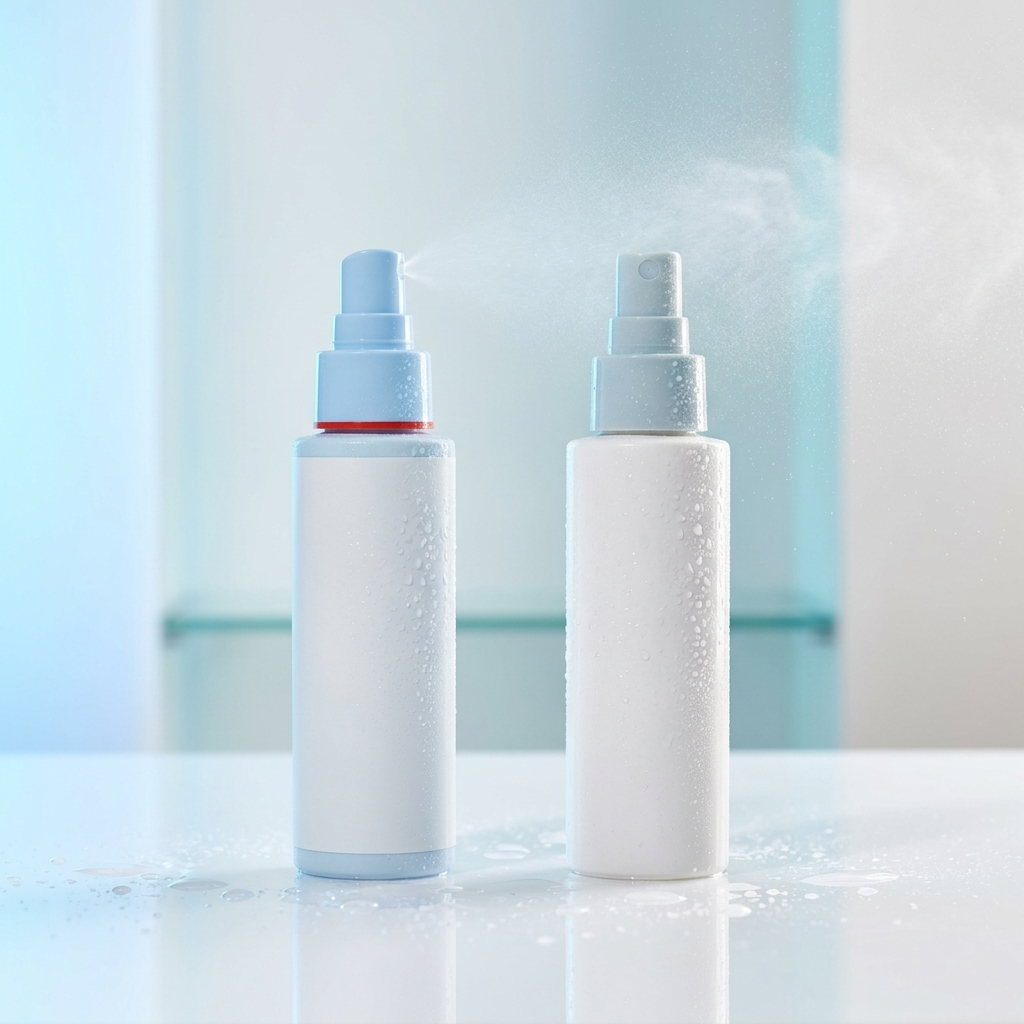

Tower 28 SOS Daily Rescue Facial Spray and Prequel Universal Skin Solution are both 4 oz facial sprays that list hypochlorous acid (HOCl) among their ingredients. Reported prices differ: $28 for Tower 28 and $17 for Prequel. The sources reviewed for this guide do not include a head-to-head clinical trial, published stability testing, or product-specific tolerability testing for these two sprays. This article therefore compares documented product specifications and neutral selection factors rather than ranking efficacy or safety.
Product identity and price details are reported by Brandefy and Chemist Confessions.
Reported Price and Size
| Product | Reported size | Reported price | Cost per reported ounce | Reported price band |
|---|---|---|---|---|
| Tower 28 SOS Daily Rescue Facial Spray | 4 oz | $28 | About $7.00 | $20 to $50 |
| Prequel Universal Skin Solution | 4 oz | $17 | About $4.25 | Less than $20 |
The cost-per-ounce figures are calculated from the reported prices and sizes. BeautyMasterList places Prequel in a less-than-$20 band and Tower 28 in a $20-to-$50 band. These are reported specifications and price bands, not performance rankings. Prices and sizes can change, so the current label or official product page is the relevant source for current details.
Reported Ingredient Lists and Concentration
The ingredient lists for these two sprays are not identical across the sources reviewed. Chemist Confessions reports 0.015% HOCl for Tower 28 and 0.02% for Prequel. Its listed ingredients are water, sodium chloride, and hypochlorous acid for Tower 28, and water described as electrolyzed water, hypochlorous acid, sodium chloride, and muriatic acid for Prequel.
| Source | Tower 28 reported ingredients | Prequel reported ingredients |
|---|---|---|
| Chemist Confessions | Water, Sodium Chloride, 0.015% Hypochlorous Acid | Water (electrolyzed water), 0.02% Hypochlorous Acid, Sodium Chloride, Muriatic Acid |
| SkinSort | Water, Sodium Chloride, Hypochlorous Acid | Water, Hypochlorous Acid, Sodium Chloride, Hydrochloric Acid |
| SkinSignal | Electrolyzed Water, Sea Salt, Hypochlorous Acid | Water, Hypochlorous Acid, Sodium Chloride, Sodium Phosphate, Disodium Phosphate |
SkinSort and SkinSignal list different orders and minor ingredients. The shared documented ingredient across the reviewed lists is hypochlorous acid, accompanied by water and sodium chloride in most listings. Because the lists do not match, the exact INCI order and minor ingredients should be confirmed on the current product label.
Product Category and Labeling
BeautyMasterList classifies both Tower 28 SOS Daily Rescue Facial Spray and Prequel Universal Skin Solution as toners/sprays, described as lightweight liquids used to refresh and prep the skin. The same source lists both products as alcohol-free, paraben-free, SLS-free, mica-free, fragrance-free, vegan, and cruelty-free. SkinSignal lists both products as neither vegan nor cruelty-free. These labeling attributes are not consistent across sources, so they should be confirmed on the current product label or official brand page.
What the Sources Do Not Establish
The reviewed sources do not provide a head-to-head clinical trial, published stability data, or product-specific safety, tolerability, or barrier measurements for Tower 28 SOS Daily Rescue Facial Spray and Prequel Universal Skin Solution. As a result, the evidence reviewed here cannot show that one spray works better than the other, is safer than the other, or is interchangeable with the other. A higher listed HOCl percentage is a labeling difference, not proof of superior performance.
Clinical Context: How Spray and Skincare Evidence Is Generated
Published clinical studies of facial sprays provide general context only. A randomized study of a birch juice facial spray evaluated 67 participants who tested positive to a lactic acid sting test and used measures including transepidermal water loss, skin blood perfusion, redness, and stratum corneum hydration over 28 days. The authors reported that both sprays significantly decreased lactic acid sting test scores, transepidermal water loss rates, skin blood perfusion, and redness while increasing stratum corneum hydration. That study tested different spray formulas, not Tower 28 or Prequel. It is available through PMC birch juice spray study.
A separate split-face study of a serum spray measured trans-epidermal water loss at baseline, 20 minutes, and 28 days. The study reported that barrier function remained within the normal range. At 20 minutes, trans-epidermal water loss in the area treated with moisturizer plus spray was on average 1% higher than with moisturizer alone; at 28 days, it was 3% lower; neither difference was statistically significant. That study tested a different product, not the two sprays in this comparison. It is available through MDPI serum spray study.
A randomized clinical evaluation of skincare products with pH below 5 measured transepidermal water loss after 28 days and reported that products had varying effects on skin barrier integrity. That study also tested different products. It is available through Springer Nature low-pH skincare study.
Another clinical study of a cream containing panthenol, prebiotics, and probiotic lysate involved 110 subjects with sensitive skin symptoms and measured outcomes before application and at 15 minutes, 1 day, 14 days, and 28 days. Participants showed significant improvements in stratum corneum moisture content, erythema index, sebum content, trans-epidermal water loss, and skin redness parameter a*. That study tested a cream, not a hypochlorous acid spray. It is available through PMC panthenol cream study.
A DailyMed label for a skin protection spray containing white petrolatum describes a study in which 29 subjects completed testing with sodium lauryl sulfate and sodium hydroxide at concentrations used to provoke irritation. The results reported that the spray protected skin exposed to the irritants after eight hours compared with unprotected skin. That product is not Tower 28 or Prequel.
These studies show how clinical skincare research measures barrier function, hydration, irritation, and redness. They do not transfer product-specific efficacy, safety, or barrier conclusions to Tower 28 or Prequel.
Safety and Personal Use
No product-specific safety or tolerability testing for either spray appears in the sources reviewed. This guide therefore cannot call either spray safe, gentle, or suitable for any particular skin type. If you have a diagnosed skin condition, use prescription treatment, or react easily to skincare products, ask a qualified clinician before adding a new spray. Otherwise, follow the directions on the product label.
Non-Medical Selection Factors
- Price per reported ounce: Prequel has the lower listed cost at about $4.25 per ounce versus about $7.00 per ounce for Tower 28. This is a price difference, not an efficacy or safety conclusion.
- Ingredient list length: Tower 28 has the shorter reported ingredient list in the Chemist Confessions report. Prequel’s Chemist Confessions list adds muriatic acid, and one database adds phosphate buffers. If a shorter INCI listing is your preference, Tower 28 matches that preference on paper.
- Listed HOCl concentration: Prequel reports 0.02% HOCl versus Tower 28’s 0.015%. The reviewed sources do not establish that the higher listed percentage performs better.
- Availability and shipping: The reviewed sources are comparison and editorial pages, not brand pages. Current price, size, shipping terms, and return policies should be checked on official brand or retailer pages.
- Directions: The reviewed sources do not provide step-by-step directions for either product. The product label is the reliable guide for use.
What to Check on the Label
If you are comparing these two sprays for personal use, check the current label for the exact ingredient list, hypochlorous acid concentration, directions, warnings, and manufacturer contact information. Confirm whether the product is intended for facial use, body use, or both; the reviewed sources do not provide body-use directions for either spray. Check any expiration date or period-after-opening information if present, because the reviewed sources do not provide shelf-life data.
Routine and Storage
The reviewed sources do not provide product-specific directions, layering guidance, frequency recommendations, patch-test data, storage instructions, shelf-life data, or stability data for Tower 28 or Prequel. No routine protocol can be stated here beyond following each product’s label. Results reported for other spray formulas should not be assumed to apply to these products.
Bottom Line
Tower 28 SOS Spray vs Prequel Universal Skin Solution can be compared on documented specifications: both are 4 oz sprays listing hypochlorous acid, with different reported prices and ingredient lists. Price per reported ounce favors Prequel; a shorter reported ingredient list favors Tower 28 on paper; a higher listed HOCl percentage favors Prequel on paper. These are specification differences, not proof of better performance. For personal skin concerns, follow the label and ask a qualified professional.