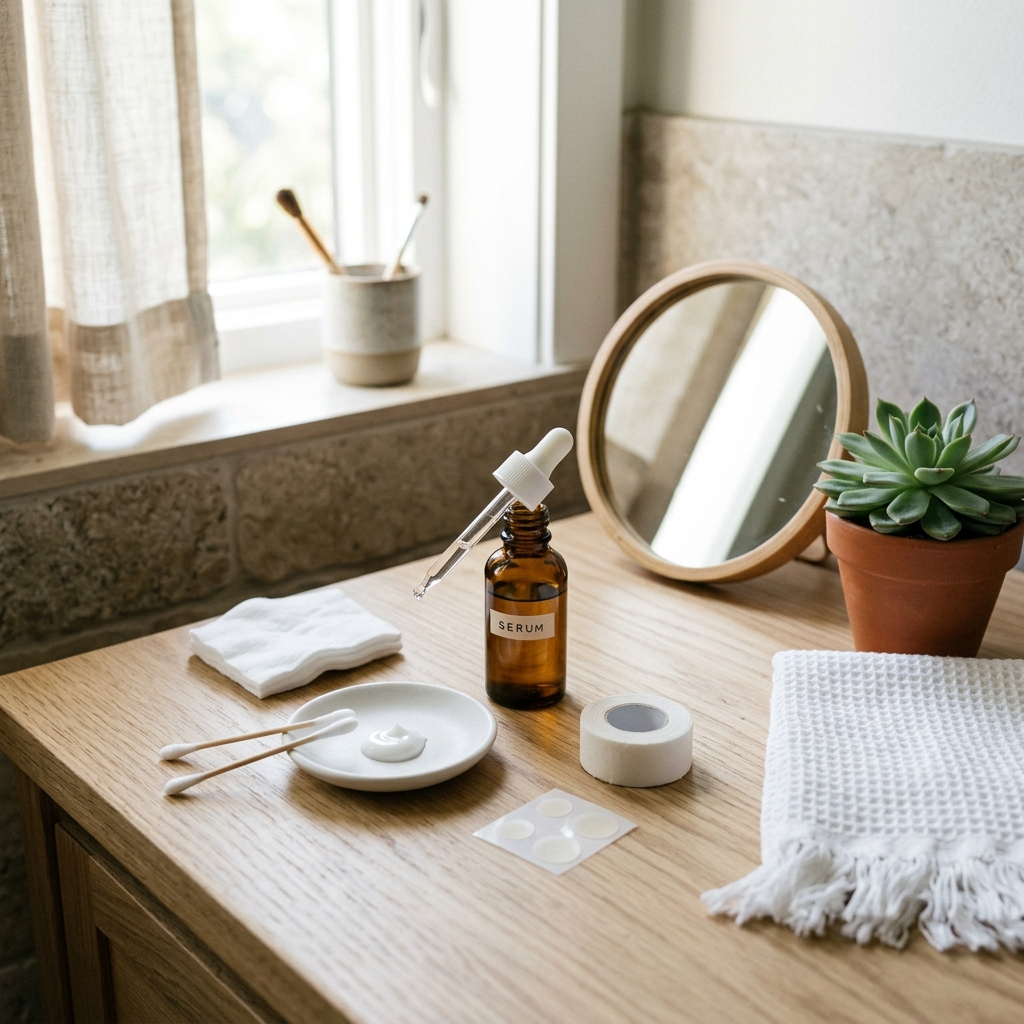
You bought a new serum. You want to see results fast. But if your skin hates it, you will find out at the worst time — on your whole face.
A patch test is a simple safety check. You use a small amount of the product on one small area of skin first. Then you watch that spot for several days. If nothing happens, you can use the product on your face with more confidence.
This guide shows you exactly how to patch test a new skincare product before using it on your face. It follows the steps dermatologists recommend. Every step is short, clear, and easy to follow at home.
Quick Answer: How to Patch Test a New Skincare Product Before Using It on Your Face
The 60-Second Overview
Here is the whole method in one breath. Clean a quarter-sized spot on your inner arm or the bend of your elbow. Put on the normal amount of product, just like you would on your face. Leave it on as long as you normally would. Repeat this twice a day for 7 to 10 days. Watch for redness, itching, or swelling. If your skin stays calm, you can start using the product.
That is the core routine recommended by the American Academy of Dermatology (AAD) for testing skincare products at home AAD.
What a Home Patch Test Can and Cannot Promise
A home patch test can show you how one small area of your skin reacts to a product. It can help you avoid a big, angry breakout on your face. It can also help you spot irritation early.
But a home test is not a guarantee. Your arm skin and your face skin are not the same. Your face is often thinner and more sensitive Healthline. A product might pass the arm test and still bother your face.
A negative result also does not prove you are allergy-free forever. Allergies can build up over time. The European Society of Contact Dermatitis notes that a negative test does not rule out a contact allergy to a product ESCD Guideline.
Home Use Test vs Professional Patch Testing
People use the phrase “patch test” for two different things. It helps to know the difference.
A home use test is what this guide teaches. You test a product yourself on a small area. It is free, easy, and useful for spotting irritation.
Professional patch testing is a medical test. A dermatologist or allergist applies small amounts of known allergens to your back using special tapes. The patches stay on for about 48 hours, then the doctor checks the skin again about 48 hours later, because reactions often take 48 to 96 hours to show up DermNet NZ. This test is used to find the exact ingredient causing a problem. It cannot be done at home.
Why You Should Patch Test a New Skincare Product Before Using It on Your Face
Irritant vs Allergic Contact Dermatitis Explained
Two different problems can happen when your skin reacts.
Irritant contact dermatitis is damage, not allergy. A strong product — like an acid or a strong cleanser — strips and roughs up your skin. Anyone can get this if the product is too harsh. It often stings or burns right away.
Allergic contact dermatitis is an immune reaction. Your body decides an ingredient is an enemy. This reaction usually takes hours or days to appear. It can look like a red, itchy, bumpy rash. It may even spread beyond where you put the product.
The treatment is different. Irritation often gets better if you use less, or if you switch to a gentler formula. A true allergy means you should stop using that ingredient for good.
Who Is Most at Risk (Sensitive Skin, Eczema, Rosacea)
Anyone can react. But some people react faster and harder.
You should be extra careful if you have:
- Sensitive skin that stings or turns red easily
- Eczema or very dry, cracked skin
- Rosacea or frequent facial redness
- A past allergic reaction to a cream, soap, or hair dye
- Broken, sunburned, or irritated skin right now
The AAD advises people with sensitive skin to apply a small amount of a new product to the skin and test it before applying it to the whole face AAD News.
How Common Skin Reactions to Skincare Really Are
Reactions are more common than most people think. The AAD states that more than 15,000 substances can cause an allergic skin reaction Medical News Today. One 2021 study found that personal care products caused irritant contact dermatitis in 28.8% of males and 39.5% of females Medical News Today.
It is also estimated that 1% to 5.4% of the population is sensitized to a cosmetic ingredient PMC Study. Fragrances and preservatives are among the most common culprits. So a patch test is not paranoia. It is just smart, low-cost insurance.
What You Need Before You Patch Test a New Skincare Product
Supplies Checklist
You do not need special equipment. Gather these simple items:
- The new product, unopened or new to you
- A gentle, fragrance-free cleanser
- A pen or marker to draw a small circle
- A small bandage or gauze pad (optional, for leave-on products)
- A timer or your phone
- Your phone camera, to photograph the spot and the ingredient list
- A notebook or note app for your diary
Reading the Ingredient List First
Before you test anything, read the label. Look for ingredients you already know bother you. Common problem makers include fragrance, essential oils, and some preservatives.
Watch your words here. “Unscented” does not always mean fragrance-free. The AAD warns that products labeled unscented, or those with plant-based botanical ingredients, may still contain fragrance-related ingredients AAD. If fragrance has bothered you before, look for “fragrance free” instead.
Products That Always Need a Patch Test (Retinol, Acids, Vitamin C)
Some products deserve a patch test every single time. These are the active ingredients that change how your skin behaves.
- Retinol and retinoids — these speed up skin turnover and often cause dryness, flaking, and redness at first
- Exfoliating acids — glycolic acid, lactic acid, salicylic acid, and peels
- Vitamin C serums — the low-pH formulas can sting
- Benzoyl peroxide and acne treatments — drying and irritating for many people
- Hair dye and strong hair products — test these on the back of your neck
The AAD notes that ingredients like retinol and glycolic acid can irritate skin, especially sensitive skin, and that this is normal and temporary AAD. A patch test helps you tell normal adjustment apart from a real problem.
How to Patch Test a New Skincare Product: Step-by-Step
Step 1 – Choose the Right Test Site
Pick a spot about the size of a quarter. Choose skin that will not be rubbed or washed away during the test. The AAD suggests the underside of your arm or the bend of your elbow AAD.
For a face product, you can also use the area behind your ear or along your jawline, because that skin is closer to facial skin Healthline. Pick a spot you can leave alone for a week. Avoid anywhere you shave or scrub.
Step 2 – Clean and Mark the Area
Wash the spot with your gentle cleanser and pat it dry. Do not put moisturizer, serum, or anything else on that exact spot.
Draw a small circle around the area with a pen or marker. This helps you apply the product to the same place every time. It also helps you see any redness at the edges later.
Step 3 – Apply the Product Correctly
Use the normal amount. Do not use a thick mountain of product to “be safe.” A thicker layer than normal can cause irritation that would never happen in real use. The AAD says to use the normal amount and thickness you would use when applying the product regularly AAD.
For face products, a small dab is enough. Healthline suggests using a smaller, dime-size amount when testing on the face area Healthline.
Optional step: cover the spot with a small bandage. This keeps the product from rubbing off. It also mimics a stronger test that dermatologists use.
Step 4 – Respect Contact Time (Leave-On vs Rinse-Off)
Leave the product on for as long as you normally would.
- Leave-on products (serum, moisturizer, sunscreen): leave them on all day or overnight as usual.
- Rinse-off products (cleanser, mask, shampoo): keep them on for 5 minutes, or follow the label instructions, then rinse gently AAD.
Do not leave a cleanser or peel on overnight just to make the test “stronger.” That is not a real test. That is a new irritation you created yourself.
Step 5 – Repeat and Observe for 7-10 Days
Apply the product to the same spot twice a day for 7 to 10 days AAD. Yes, this is slow. But allergies do not always show up on day one. A delayed reaction needs repeated contact to appear.
During these days, keep the rest of your routine the same. Do not start any other new product. Take a photo each day with the same lighting so you can compare.
Step 6 – Interpret Your Results
On day 7 to 10, look closely at the spot.
- No redness, no itch, no bumps: You can start using the product as directed AAD.
- Mild redness or dryness only: This may be normal adjustment, especially with actives. Wait for it to settle, then start slowly.
- Itching, swelling, bumps, or a spreading rash: This looks like a reaction. Stop using the product.
Where to Patch Test a New Skincare Product: Face-Friendly Test Sites Compared
| Test Site | Best For | Good Points | Watch Out For |
|---|---|---|---|
| Inner forearm | Any product | Easy to see, easy to cover, unlikely to be washed | Thicker skin than your face, so it may be less sensitive |
| Behind the ear | Face products | Thin, sensitive skin close to facial skin | Harder to see; keep hair away from it |
| Along the jawline | Face products | Closest match to facial skin | Visible; easy to rub by accident |
| Back of the neck | Hair products, hair dye | Mimics real contact points | Collars and hair can rub the product off |
Inner Forearm
The inner forearm is the default choice. The AAD points to the underside of the arm and the bend of the elbow AAD. It is flat, easy to reach, and rarely washed by accident. The catch is that arm skin is tougher than face skin. A calm arm does not fully promise a calm face.
Behind the Ear and Along the Jawline
These spots sit right next to your face, so they give a better preview of how your face may behave Healthline. The FDA even describes testing on the antecubital fossa (the inner elbow) and behind the ear for facial dermatitis FDA. Use these sites for serums, creams, and moisturizers.
Back of the Neck
Testing on the back of the neck is smart for hair products and hair dye Healthline. Hair dye reactions can be severe, so never skip this step. Keep your hair pinned up and your collar away from the spot.
Sites to Avoid
Do not test in these places:
- Near your eyes or on your eyelids
- On your lips or inside your mouth
- On broken skin, a cut, a rash, or a healing pimple
- On sunburned or freshly exfoliated skin
- On skin you have just shaved or waxed
Damaged skin gives false results. It will react to almost anything.
How Long and How Often to Patch Test a New Skincare Product
The 30-Minute, 24-Hour, 48-Hour, and 96-Hour Checkpoints
Do not just look once. Check at set times.
| Checkpoint | What You Are Looking For |
|---|---|
| 30 minutes | Immediate stinging, burning, or hives. A fast reaction can signal contact urticaria FDA. |
| 24 hours | Early redness, itching, or swelling. |
| 48 hours | Delayed reactions often start here. This is the standard first reading time in medical patch testing DermNet NZ. |
| 96 hours | Late reactions. Doctors usually check again at this point DermNet NZ. |
Keep applying the product on the normal twice-a-day schedule between these checkpoints.
Why the AAD Recommends 7-10 Days
Seven to 10 days gives your immune system time to respond if it is going to. The AAD’s method is twice daily for 7 to 10 days AAD. Medical use tests follow a similar window; the FDA describes applying the product twice a day for about 7 to 14 days when checking a facial product FDA. Short tests catch irritation. Longer tests catch allergy.
Testing Rinse-Off vs Leave-On Formulas
- Leave-on (serum, cream, sunscreen): apply and leave it. Do not wash the spot until the next scheduled step.
- Rinse-off (cleanser, mask, shampoo, body wash): apply, wait 5 minutes or follow the label, then rinse AAD.
The rule is simple: test the product the way you will actually use it. Real use is what you are testing for.
Signs of a Reaction When You Patch Test a New Skincare Product
Mild vs Severe Symptoms
Mild signs may include slight redness, mild dryness, a little flaking, or a faint tingle that fades. With actives like retinol or glycolic acid, some of this is expected and temporary AAD.
Severe signs should make you stop at once:
- Strong itching that makes you want to scratch
- Swelling or puffiness
- Raised bumps, blisters, or oozing
- A rash that spreads past the test spot
- Burning pain that does not settle
- Hives or trouble breathing (get medical help right away)
What to Do If You React
Act fast and keep it simple.
- Gently wash the product off with lukewarm water.
- Do not use the product again.
- Apply a cool compress or a thin layer of petroleum jelly to calm the skin AAD.
- Skip other actives on that area until it heals.
- Write down the date, the product, and your symptoms in your diary.
When to See a Dermatologist
See a dermatologist if your reaction is severe and does not calm down with a cool compress or petroleum jelly AAD. Also book a visit if you keep reacting and cannot figure out which ingredient is the problem. A board-certified dermatologist can run professional patch testing to name the exact allergen Cleveland Clinic. Bring your diary and photos.
How to Patch Test a New Skincare Product and Introduce It Safely
One New Product at a Time
Start only one new product at a time. If you start a cleanser, a serum, and a moisturizer in the same week and your face turns red, you will not know which one did it. The AAD advises introducing one new product at a time so your skin can tolerate it AAD News. Wait about a week before adding the next one.
Slow Introduction and Building Tolerance
A passed patch test means “go slowly,” not “go wild.” Start with a small area of your face, such as one cheek. Use the product once or twice a week at first. Then build up to daily use as your skin stays calm. This is how you build tolerance, especially with actives.
Keeping a Patch Test and Reaction Diary
Write down a few short notes:
- Product name and the date you started
- A photo of the ingredient list
- Where you tested it
- Any symptoms, and on which day they appeared
Keep this record for at least two weeks after full use. If you ever need a dermatologist, this diary is gold.
Common Mistakes When You Patch Test a New Skincare Product
Testing on Broken or Irritated Skin
Testing on a rash, a cut, or freshly exfoliated skin ruins the test. That skin is already inflamed, so it will react to nearly everything. Always pick clean, intact, calm skin.
Skipping the Full 7-10 Days
A 24-hour test is not enough. Many reactions are delayed and only appear after repeated use Healthline. If you stop at day one, you may miss the very reaction you were trying to catch.
Mistaking Purging for Irritation
Ingredients like salicylic acid can cause “purging” — faster pimples in places you already break out. Purging is not the same as irritation. Irritation shows up as redness, stinging, and peeling in areas that were clear before. On a patch test site that is not acne-prone, any bumps are a warning sign, not purging.
FAQ: How to Patch Test a New Skincare Product Before Using It on Your Face
Can I patch test directly on my face?
You can test a small spot on your face, such as along the jawline or behind the ear. Some people prefer this because face skin reacts differently from arm skin Healthline. Just keep the spot small and away from your eyes and lips.
How long should I wait before full-face use?
Wait the full 7 to 10 days with no reaction AAD. Then start on a small area of your face and build up slowly.
What if I see slight redness but no itching?
Slight redness alone is often irritation or normal adjustment, especially with actives AAD. Let it settle. Then try again with a smaller amount, or layer the product over moisturizer to see if it is better tolerated Everyday Health. If redness gets worse or you develop itching, stop.
Does a negative patch test mean the product is safe forever?
No. A negative test is useful information, not a lifelong guarantee. Allergies can develop later, and a negative result does not fully exclude a contact allergy ESCD Guideline. If your skin starts reacting months later, stop using the product.
Can I patch test more than one product at once?
Not on the same spot. You can test two products on two clearly separate, labeled spots. But do not start using two new products on your face at once. If a reaction happens, you will not know the cause.
Final Recommendations: How to Patch Test a New Skincare Product
Patch testing is not a complicated ritual. It is one small habit that protects your whole face.
Here is your action plan:
- Read the label and note any ingredients you already know bother you.
- Pick a quarter-sized spot on your inner arm, behind your ear, or along your jawline.
- Apply the normal amount, twice a day, for 7 to 10 days.
- Check at 30 minutes, 24 hours, 48 hours, and 96 hours.
- Stop at the first sign of itching, swelling, or a spreading rash, and wash the product off.
- If your skin stays calm, start with one product and build up slowly.
- Keep a simple diary of dates, symptoms, and photos.
Ten days of patience can save you weeks of redness. Test first, then glow.