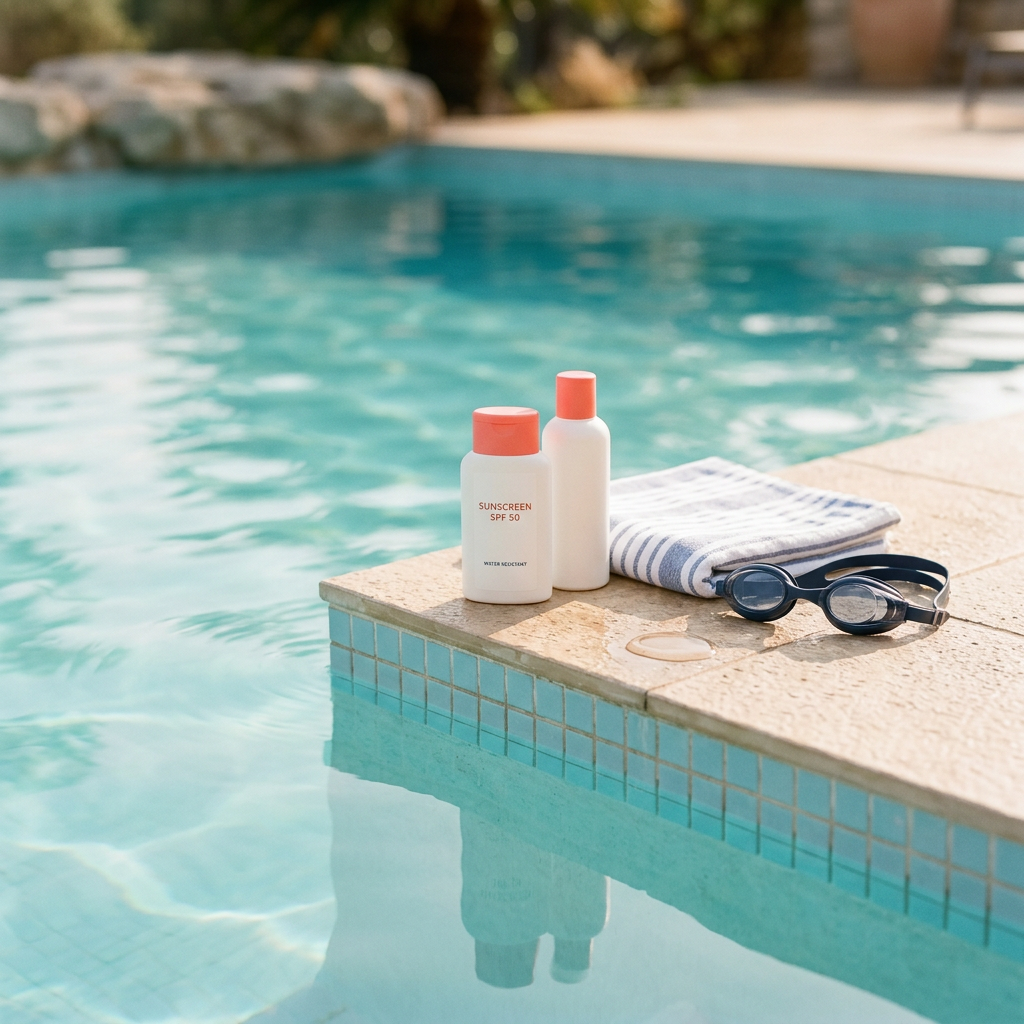
Swimming feels cool, but the sun is still working on your skin. Water washes sunscreen off. Water also bounces UV rays back at you. That double hit is why the wrong bottle can leave you burned even on a cloudy pool day.
This guide explains how to choose water resistant sunscreen for swimming in plain steps. No chemistry degree needed. Just read the label, pick the right formula, and reapply on time.
Quick Answer: How to Choose Water Resistant Sunscreen for Swimming
Buy a broad-spectrum sunscreen with SPF 30 or higher that says “water resistant (80 minutes)” on the label. Put it on dry skin about 15 minutes before you get wet. Reapply after 80 minutes in the water, right after towel drying, and at least every 2 hours. That is the short version. The rest of this guide explains why each step matters.
The 3-Step Swimmer’s Decision Checklist
Use this list at the store. It takes about one minute.
- Check the water-resistance time. The label must state 40 minutes or 80 minutes. Water-resistant sunscreen is tested, and the label has to tell you how long it holds up while swimming or sweating. Source: FDA
- Check the protection level. Look for SPF 30 or higher plus the words “broad spectrum.” Dermatologists recommend those two features together with water resistance. Source: AAD
- Check the formula and fit. Match the type (lotion, stick, or spray) to your skin and your activity. Then plan how you will reapply while your hands are wet.
Before you shop or head to the pool, gather a few simple items. Nothing here is expensive or hard to find.
- A water resistant sunscreen labeled 80 minutes, SPF 30 or higher, broad spectrum
- A lip balm with SPF 30 or higher
- A wide-brimmed hat, sunglasses, and a swim shirt or other sun-protective clothing
- A phone timer or waterproof watch
- A towel plus a shady spot to rest
Sunscreen is only one part of sun safety. The FDA suggests limiting time in the sun between 10 a.m. and 2 p.m., wearing clothing that covers exposed skin, and using broad-spectrum sunscreen with SPF 15 or higher. Source: FDA For a long pool day, aim higher than that minimum.
Key Label Terms to Look For First
Front labels sell. Back labels tell the truth. These are the terms that matter.
| Label term | What it tells you | Why it matters in water |
|---|---|---|
| SPF 30 or higher | Strength against UVB rays, the main burn rays | Lower SPF gives less room for error when sunscreen washes off |
| Broad spectrum | Covers UVA and UVB rays | UVA passes through water and reaches deeper skin |
| Water resistant (40 minutes) | Stays effective for 40 minutes of swimming or sweating | Good for short dips and quick swims |
| Water resistant (80 minutes) | Stays effective for 80 minutes of swimming or sweating | Best for laps, long swims, and heavy sweat |
| Active ingredients | The UV filters in the product | Helps you compare mineral and chemical options |
| Expiration date | How long the product is good | Old sunscreen may not protect you well |
What “Water Resistant” Really Means
“Water resistant” does not mean the sunscreen stays on all day. It means the product passed a test and keeps working for a set time on wet skin. The label must say 40 minutes or 80 minutes. Source: FDA
It also does not mean you can skip reapplication when you stay dry. Even on dry skin, sunscreen needs a fresh coat every 2 hours. Source: AAD
Federal labeling rules use the exact wording “Water resistant (40 minutes)” or “Water resistant (80 minutes).” If a product is not water resistant, the label has to advise you to use a water-resistant sunscreen when swimming or sweating. Source: DermNet
How to Choose Water Resistant Sunscreen for Swimming: Master SPF and Broad-Spectrum Protection
SPF and water resistance are two different things. Confusing them is the most common shopping mistake. Here is how each one works.
What the SPF Number Means in the Water
SPF stands for sun protection factor. It measures how well a product shields you from UVB rays, which cause sunburn. SPF 30 blocks about 97% of UVB rays. SPF 15 blocks about 94%, and SPF 50 blocks about 98%. Source: peer-reviewed guide
The number is a strength rating, not a clock. It does not tell you how long the product stays on your skin in a pool.
UVA vs UVB: Why Broad Spectrum Matters for Swimmers
UVB rays are shorter and cause sunburn on the outer skin. UVA rays are longer. They go deeper, and they play a role in early skin aging and skin cancer. Both types reach you at the pool, and water reflects them back at your face and shoulders.
Only sunscreens that pass a separate FDA test for UVA coverage may print “broad spectrum” on the label. Broad-spectrum products protect against both UVA and UVB rays. Source: FDA A sunscreen that is broad spectrum, water resistant, and SPF 30 or higher helps protect your skin from sunburn, early skin aging, and skin cancer. Source: AAD
Why a Higher SPF Doesn’t Last Longer in the Pool
A higher SPF blocks slightly more UVB. It does not stay on longer. Higher-number SPFs still need reapplication on the same schedule as lower ones. Source: AAD
Here is a simple way to remember it. SPF is how strong. Water resistance is how long. A very high SPF with no water-resistance claim will wash off fast. So when you plan how to choose water resistant sunscreen for swimming, never trade water resistance for a bigger number.
How to Choose Water Resistant Sunscreen for Swimming: Decode the 40-Minute vs 80-Minute Labels
Both labels are good. They just cover different swim lengths. Pick based on how long you stay wet.
Water Resistant (40 Minutes) Explained
The sunscreen stays effective for 40 minutes in the water or while you sweat. After that, you need more. Source: AAD
This works well for splash time, short wading, and quick dips. It is not the best pick for laps. If you swim for 45 minutes, you will pass the limit with no protection left.
Water Resistant (80 Minutes) Explained
The sunscreen stays effective for 80 minutes in the water. One dermatology association calls this “very water resistant.” You still need to reapply after 80 minutes. Source: AAD
Choose 80 minutes if you swim laps, play water polo, or sweat heavily. Set a timer on your phone. When it rings, get out and reapply.
Why “Waterproof” and “Sweatproof” Claims Are Banned
There is no such thing as waterproof sunscreen. All sunscreens wash off over time. That is why the FDA no longer allows the words “waterproof,” “sweatproof,” or “sunblock” on sunscreen labels. Source: FDA
If you see a bottle that still claims to be waterproof, treat that as a warning sign. It is either mislabeled or sold outside U.S. rules. Source: AAD
How to Choose Water Resistant Sunscreen for Swimming by Formula Type
Now you know the label. Next, pick the format that fits your skin and your swim style.
Mineral vs Chemical Filters: Which Resists Water Better
Neither type wins by default. Water resistance comes from the formula, not the filter. Manufacturers use film-forming ingredients such as silicones and polymers. These create a water-hating layer that is harder to rinse off. Source: peer-reviewed swimmer study
Mineral filters are zinc oxide and titanium dioxide. They are generally well tolerated and work right away. Their thicker texture can suit sports and water activities. Chemical filters like avobenzone are often lighter and leave less white cast. Source: peer-reviewed guide
Both kinds form a protective layer that absorbs the sun’s rays. Either one can work for you if the product is broad spectrum, water resistant, and SPF 30 or higher. Source: AAD
Lotions, Sticks, and Sprays: Best Formats for Wet Skin
Each format has a job. Use them together.
- Lotion or cream: Best for arms, legs, and the torso, especially before you get wet. Use it as your base coat.
- Stick: Great for the nose, lips, ears, and the skin around the eyes. Easy to use with wet hands. Source: DermNet
- Spray: Handy for hard-to-reach spots like your back. Do not spray it directly on your face, and avoid spraying in wind. Wind gusts can blow away most of the product before it lands. Source: DermNet
Check the label before you buy. The FDA allows sunscreen in lotion, cream, stick, gel, oil, butter, paste, ointment, spray, and powder forms. Wipes, towelettes, body washes, and shampoos with SPF cannot be legally sold as sunscreen. Source: FDA
Reef-Safe and Ocean-Friendly Water Resistant Sunscreen
“Reef-safe” and “ocean-friendly” are not FDA-defined terms on sunscreen labels. Treat them as marketing, not proof. Instead, flip the bottle and read the active ingredient list.
Mineral filters such as zinc oxide and titanium dioxide are generally well tolerated and give immediate protection. Source: peer-reviewed guide Many swimmers who care about the ocean start there. Whatever you pick, read the label carefully so you know what you are putting on your skin. Source: FDA
How to Choose Water Resistant Sunscreen for Swimming by Skin Type and Activity
Your skin and your swim setting change the best pick. Use these quick rules.
Sensitive and Acne-Prone Skin
Start with mineral filters. Zinc oxide and titanium dioxide are generally well tolerated, and they work as soon as you put them on. Source: peer-reviewed guide
If your skin breaks out easily, choose a lighter gel or lotion instead of a heavy cream. Test any new bottle on a small patch of skin a day before your swim. Then you will know how your skin reacts.
Pool vs Open Water vs Sweat-Heavy Sports
Water washes sunscreen off. The cooling effect of the water can also trick you into thinking you are not burning. On top of that, water reflects UV rays, which raises your exposure. Source: NHS
For pools, a 40-minute product is fine for short dips. For open water, lakes, or the sea, choose 80 minutes and add a swim shirt. Salt and waves remove sunscreen faster than a calm pool. For running, cycling, or team sports in the heat, the FDA treats sweating the same as swimming for reapplication. Use the same timer. Source: FDA
Kids and Family Swimming
For babies under 6 months, talk to a health care professional before using sunscreen. Source: FDA Shade, clothing, and a stroller cover are safer for that age.
For older kids, the rules are the same as for adults: SPF 30 or higher, broad spectrum, water resistant. Reapply after every swim and after towel drying. Keep a stick in the pool bag for faces and ears.
How to Apply and Reapply Water Resistant Sunscreen for Swimming
Choosing the right bottle is only half the job. How you use it decides how well it works.
How Much to Use: The Shot-Glass Rule
An average adult needs about 1 ounce of sunscreen, roughly a shot glass, to cover the body. Source: FDA In teaspoon terms, that is about 6 to 8 teaspoons for full-body coverage. Source: NHS
Most people use far too little. A thin smear gives you less protection than the label promises. Source: NHS A useful pattern is one teaspoon for each arm, each leg, the front of the torso, the back of the torso, and the face and neck. Source: peer-reviewed guide
Timing: Apply Before You Get Wet
Apply sunscreen before you go outside. Your skin needs about 15 minutes to absorb it. If you wait until you are in the sun, your skin is unprotected and can burn. Source: AAD
For water-resistant formulas, allow 15 to 30 minutes to dry before you enter the water. Source: peer-reviewed consensus Applying to dry skin also helps the product cling. Wet skin dilutes the film before it sets.
Reapplication After Swimming and Towel Drying
Reapply straight after you have been in the water, even if the product is water resistant. Do the same after towel drying, after sweating, or any time it may have rubbed off. Source: NHS
Rubbing with a towel removes sunscreen faster than water alone. So a quick dry-off means a quick reapply. Then keep to the 2-hour rule while you are outdoors. Source: AAD
How to Choose Water Resistant Sunscreen for Swimming: Common Mistakes to Avoid
These three errors cause most pool-day sunburns. Fix them and you will be in good shape.
Relying on Misleading Waterproof Claims
No sunscreen is waterproof or sweatproof. All of them eventually wash off, which is why those words are banned from labels. Source: FDA
If you trust a fake “all-day waterproof” claim, you will stay in the water far past your real protection window. Check the 40- or 80-minute number instead.
Missing Hard-to-Reach and Frequently Forgotten Areas
People forget the same spots again and again. The FDA lists these common gaps: ears, nose, lips, back of the neck, hands, tops of the feet, along the hairline, and any exposed scalp. Source: FDA
For your back, ask a friend to help or use a spray sunscreen. Source: AAD Use an SPF 30 lip balm for your lips and a hat for your scalp.
Using Expired or Degraded Sunscreen
People who get sunburned often made one of three mistakes. They did not reapply, they used too little, or they used an expired sunscreen. Source: AAD
Check the date on the bottle before your first swim of the season. If the product has changed color, smell, or texture, replace it.
FAQ: How to Choose Water Resistant Sunscreen for Swimming
Is SPF 50 better than SPF 30 for swimming?
SPF 50 blocks slightly more UVB than SPF 30, about 98% versus about 97%. Both need the same reapplication schedule, and neither lasts longer in the water. Source: peer-reviewed guide The bigger win for swimmers is choosing a water resistant product with the 80-minute label.
How often should I reapply while swimming?
Reapply after the time stated on the label, either 40 or 80 minutes. Also reapply right after towel drying, after sweating, and at least every 2 hours outdoors. Source: AAD
Is mineral sunscreen more water resistant than chemical?
Not by itself. Water resistance depends on the film-forming ingredients in the formula, not on whether the filters are mineral or chemical. Source: peer-reviewed swimmer study A well-made chemical sunscreen can resist water just as well as a mineral one.
Do I need water resistant sunscreen if I’m just in the pool?
Yes, if you will sweat or touch water. Water washes sunscreen off, and pool water reflects UV rays back onto your skin. Source: NHS Even a casual float in the shallow end counts as water contact.
Conclusion and Final Recommendations
Choosing the right sunscreen for swimming comes down to three checks. Look for a set water-resistance time of 40 or 80 minutes. Look for SPF 30 or higher plus broad spectrum. Then use enough product and reapply on schedule.
Here are advanced tips to raise your protection a notch:
- Keep two products in your pool bag: an 80-minute lotion for the body and an 80-minute or 40-minute stick for your face, ears, and lips.
- Set a repeating 80-minute timer when you first get in the water. Do not rely on feeling burned, because water cools your skin and hides the warning signs.
- Reapply before your skin feels hot or tight. Waiting for a burn signal means the damage has started.
- Use sunscreen with shade, a hat, sunglasses, and a swim shirt. Clothing does not wash off. Source: FDA
- Store your sunscreen out of direct sun and heat, and replace it when the date passes.
Your next step is simple. Open your current bottle and check two things: the SPF and the water-resistance time. If either one falls short, add a better bottle to your bag before your next swim. Do that, and you will know exactly how to choose water resistant sunscreen for swimming every time.