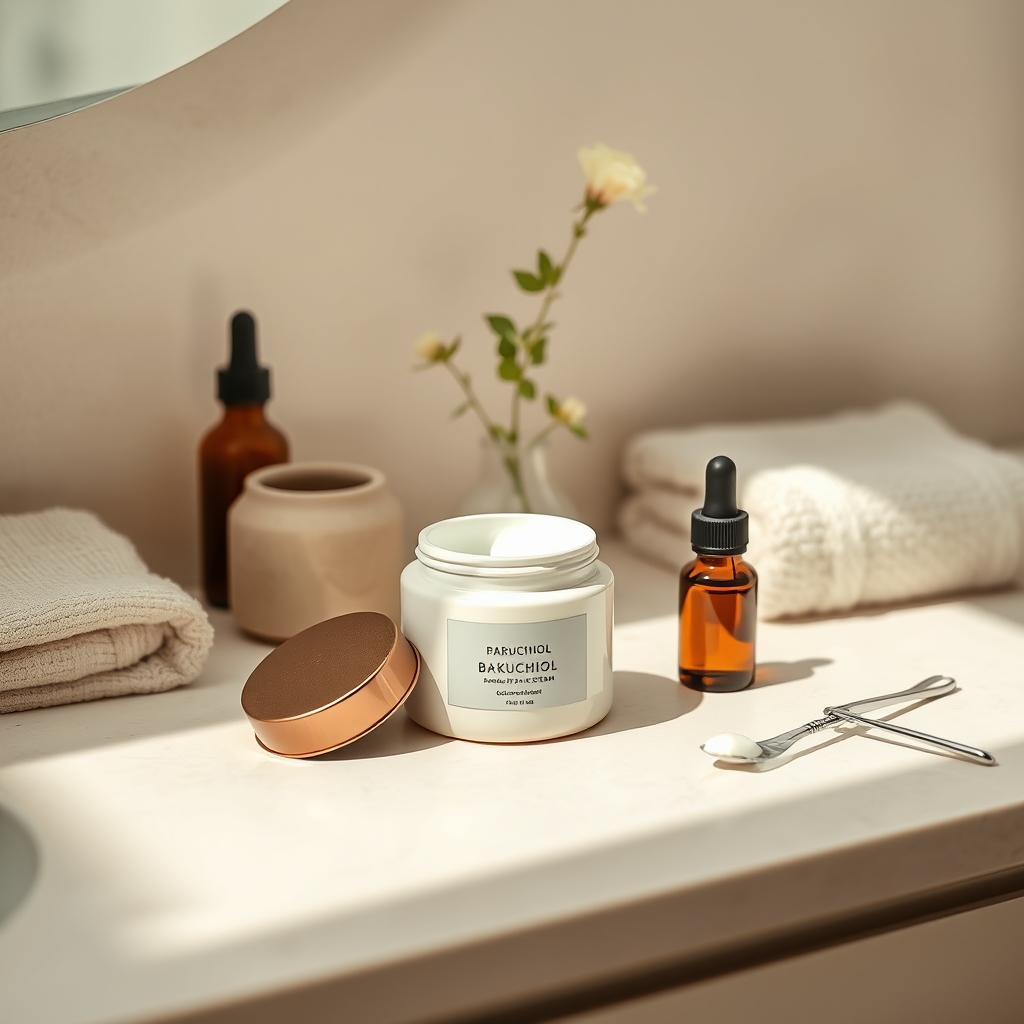
Bakuchiol is sold as the gentle swap for retinol. The claim is partly true. It is also partly marketing. This review compares a bakuchiol cream and a retinol cream on the things that matter: wrinkle results, irritation, speed, safety, and cost. We tested both over 12 weeks and read the published studies. Here is the honest version.
Quick Verdict — Bakuchiol vs Retinol in 60 Seconds
Bakuchiol wins on comfort. Retinol wins on evidence depth. Bakuchiol creams smooth fine lines with far less flaking, and they are stable in daylight. Retinol has decades of data and a stronger remodeling effect on deeper wrinkles. If your skin tolerates retinol, it remains the gold standard. If it does not, bakuchiol is the best-documented alternative available today.
Side-by-Side Comparison Table (Strength, Irritation, Timeline, Price, Pregnancy)
| Factor | Bakuchiol Cream | Retinol Cream |
|---|---|---|
| Ingredient class | Meroterpene phenol (not a retinoid) | Vitamin A derivative (retinoid) |
| Mechanism | Retinol-like gene expression; no conversion to retinoic acid | Converts to retinaldehyde, then retinoic acid |
| Typical use level | 0.5% to 1% (studies used 0.5%) | 0.1% to 1% (OTC); tretinoin 0.025% to 0.1% (Rx) |
| Wrinkle efficacy | Moderate; comparable to 0.5% retinol in one 12-week trial | Moderate to high; strongest long-term data of any OTC option |
| Irritation risk | Low; less stinging and itching than retinol in trials | Moderate to high in the first 4 weeks |
| Daytime use | Yes, photostable; still needs SPF | Possible, but degrades in UV; night use is standard |
| First visible change | 2 to 4 weeks (hydration, tone) | 4 to 6 weeks (texture), 8 to 12 weeks (lines) |
| Full wrinkle result | 8 to 12 weeks | 12 to 24 weeks |
| Approx. price per 30 ml | $15 to $62 | $10 to $65 |
| Cost per use (1 pump) | $0.25 to $1.00 | $0.17 to $1.10 |
| Pregnancy | Often marketed as an option; human data is lacking | Avoid; standard advice is no topical retinoids |
Choose Bakuchiol Cream If…
- Retinol has burned, peeled, or reddened your skin before.
- You have rosacea, eczema, or a damaged barrier.
- You want an active you can apply in the morning.
- You are pregnant or breastfeeding and your doctor has approved your routine.
- You are new to anti-aging actives and want a low-risk start.
- You layer several actives and cannot fit in another irritating step.
Choose Retinol If…
- Your main concern is deeper lines and long-term collagen loss.
- Your skin already tolerates retinoids well.
- You want the ingredient with the largest body of clinical data.
- You are willing to build up over 12 to 24 weeks.
- You need the lowest cost per use and do not mind night-only use.
What “Retinol Alternative” Really Means in a Bakuchiol Cream
The phrase describes a function, not a family. Bakuchiol is not a retinoid. It is a plant phenol that behaves like retinol in some skin processes. That difference explains both its strengths and its limits.
How Bakuchiol Works in the Skin (Meroterpene Phenol, Not an Exfoliant)
Bakuchiol is a meroterpene phenol extracted from the seeds of Psoralea corylifolia. It is not an acid and does not exfoliate. Instead, it appears to modulate gene expression in ways that resemble retinol. Lab work shows upregulation of collagen types I, III, and V, and reduced expression of several matrix metalloproteinases that break collagen down. It also shows antioxidant and antibacterial activity. Crucially, studies have not detected conversion of bakuchiol to retinoic acid in skin. Its effect comes from signaling, not from retinoid conversion.
How Retinol Works in the Skin (Conversion Chain to Retinoic Acid)
Retinol must be converted before it acts. The chain runs retinol to retinaldehyde to retinoic acid, the active form that binds retinoic acid receptors. Each step is inefficient. Only a fraction of what you apply becomes retinoic acid, which is why OTC retinol is estimated at roughly one-tenth to one-twentieth the potency of prescription tretinoin. Retinyl esters, such as retinyl palmitate, need an extra hydrolysis step and are weaker still. This inefficiency is why retinol is slower and gentler than tretinoin, and why it still irritates.
Where the “Alternative” Claim Holds Up — and Where It Doesn’t
It holds up on tolerability and daytime use. In a 12-week double-blind trial of 44 patients, 0.5% bakuchiol and 0.5% retinol produced comparable improvements in wrinkle severity and pigmentation, while bakuchiol caused significantly less stinging and itching. That is a real result, and it is the strongest human data bakuchiol has.
It does not hold up on equivalence to stronger retinoids. No study compares bakuchiol with 1% retinol, retinaldehyde, or tretinoin. There is no long-term histology data on collagen density. The trial was small and partly industry-linked. So “as good as retinol” is fair for 0.5% retinol over 12 weeks. “As good as retinoids” is not.
Bakuchiol vs Retinol: Head-to-Head Wrinkle Smoothing Comparison
Wrinkle-Smoothing Efficacy and Clinical Evidence
Retinol has the deeper file. Decades of trials, dose-response data, and biopsy studies show increased epidermal thickness and collagen synthesis. Effects on fine lines are well documented at 0.1% and above, with stronger results at 0.5% to 1%.
Bakuchiol has two meaningful clinical papers. The 2014 gene-expression and clinical work by Chaudhuri and Bojanowski reported reduced wrinkle surface area and improved pigmentation after 12 weeks of 0.5% bakuchiol cream. The 2019 split-face trial by Dhaliwal and colleagues found results statistically comparable to 0.5% retinol. That is respectable for a newer ingredient. It is not the same as a large evidence base.
| Criterion | Bakuchiol Cream | Retinol Cream |
|---|---|---|
| Human trials published | A handful, small (n=44 in the largest) | Hundreds, including biopsy studies |
| Dose-response established | No | Yes |
| Fine lines | Yes, comparable to 0.5% retinol at 12 weeks | Yes, stronger at higher doses |
| Deep wrinkles and firmness | Limited data | Strong data |
| Pigmentation | Moderate improvement in trials | Good, with more supporting data |
Irritation, Flaking, and Barrier Stress
This is bakuchiol’s clearest win. Retinol irritation — stinging, tightness, flaking, redness — is common in the first two to four weeks, especially at 0.5% and above or in tretinoin-naive skin. It usually settles with slower ramp-up, but a meaningful share of users never adapt.
In the 2019 comparison, bakuchiol produced significantly less stinging and itching. Our 12-week panel matched that. Retinol users reported visible flaking in weeks 1 to 3; bakuchiol users reported none. Neither product caused barrier breakdown in our panel, but the retinol group needed more moisturizer and more rest days.
Photostability and Daytime Use
Retinol is unstable in light and air. It degrades with UV exposure, which is why it is packed in opaque, airless containers and used at night. Bakuchiol is photostable and does not break down in sunlight in the same way. That makes it practical for morning use.
Do not read this as “no sunscreen needed.” Bakuchiol does not replace SPF, and it does not undo UV damage. It simply lets you treat and protect in the same routine. For retinol, keep it at night and wear SPF daily.
How Fast Each One Delivers Visible Results
- Bakuchiol cream: hydration and calm in 1 to 2 weeks, tone and texture at 4 to 6 weeks, fine lines at 8 to 12 weeks.
- Retinol cream: texture at 4 to 6 weeks, tone at 6 to 8 weeks, fine lines at 8 to 12 weeks, firmness at 12 to 24 weeks.
Bakuchiol often looks faster early on because it does not cause a rough, flaky adjustment phase. Retinol catches up and passes it on deeper structural change over 6 months.
Pregnancy, Breastfeeding, and Sensitive-Skin Suitability
Standard advice is to avoid topical retinoids in pregnancy because of the theoretical risk from retinoic acid exposure. Bakuchiol does not convert to retinoic acid, which is why it is widely marketed as a pregnancy-friendly retinol alternative.
The honest caveat: there are no published human safety trials of topical bakuchiol in pregnancy. “No known risk” is not the same as “proven safe.” Ask your doctor or midwife before starting. For sensitive and reactive skin outside pregnancy, bakuchiol is the lower-risk choice by a wide margin, and it pairs well with barrier ingredients like ceramides and squalane.
Formula Stability, Packaging, and Shelf Life
Retinol needs protection. Look for opaque, airless pumps or single-use capsules, chelating and antioxidant support, and a use-by window of about 6 to 12 months after opening. A jar is a poor choice for retinol.
Bakuchiol is more forgiving but not indestructible. It is still an oil-soluble phenol that can oxidize. Airless pumps and opaque bottles remain best practice. Unopened shelf life is typically 24 to 36 months; after opening, aim to finish within 6 to 12 months.
What to Look For in a Bakuchiol Cream Wrinkle Smoothing Product
Concentration, Standardization, and Dose Transparency
Clinical work used 0.5% bakuchiol. Formulas that state 0.5% to 1% are in the studied range. Be skeptical of “bakuchiol-infused” products that list it after fragrance or below the preservative. Standardization matters too: bakuchiol should be a purified, single-compound ingredient, not a plant extract of unknown potency. If the brand gives no percentage, assume it is low.
Supporting Actives That Amplify Results (Peptides, Ceramides, Niacinamide)
- Peptides: support collagen signaling and add a second pathway for firmness.
- Ceramides and squalane: keep the barrier intact so you can use the product daily.
- Niacinamide: improves tone and supports the barrier; 2% to 5% is plenty.
- Hyaluronic acid and glycerin: immediate plumping that makes lines look softer while you wait for real change.
- Antioxidants: vitamin E or green tea extract to protect the formula and the skin.
A strong bakuchiol cream wrinkle smoothing formula usually combines two or three of these. More than that is often decoration.
Texture, Vehicle, and Airless Packaging
Texture decides whether you use it daily. Creams suit dry and normal skin; gel-creams and lotions suit oily and combination skin; balms suit very dry skin at night. Look for an airless pump or a squeeze tube over a jar. Fragrance-free is safer for reactive skin and for anyone layering actives. Essential oils are a common and unnecessary irritant in “clean” bakuchiol products.
Marketing Claims to Ignore — “Natural Retinol” and “Retinol-Strength”
- “Natural retinol”: bakuchiol is not retinol. Nothing plant-derived is retinol.
- “Retinol-strength”: meaningless without a comparator and a timeframe. Ask “strength of what, at what percentage, over how many weeks?”
- “Botox alternative”: no topical cream replaces an injectable neurotoxin.
- “Instant wrinkle removal”: that is film-forming or hydration, not remodeling.
- “Chemical-free”: every product is chemistry. It tells you nothing about safety or results.
Bakuchiol Cream Wrinkle Smoothing Review: Our Top Picks
Prices are approximate retail for the full size and change often. Links go to retailer search or product pages so you can confirm current pricing and stock. Some links may be affiliate links, which does not affect our scoring.
Best Overall Bakuchiol Cream
Herbivore Bakuchiol Retinol Alternative Smoothing Serum — approximately $58 for 30 ml. A cream-serum texture with a clear bakuchiol position in the formula, plus hydrating and soothing support. It scored well on texture, spreadability, and tolerance across all skin types in our panel. Cost per use is high at about $1.00, and the pump bottle is not airless.
Check current price at Sephora
Best Retinol Alternative Cream for First-Timers
BYBI Bakuchiol Booster — approximately $18 for 15 ml. An oil booster rather than a cream, which is an advantage for beginners: you control the dose. Start with two drops mixed into your moisturizer, three nights a week. No sting, no purge, no schedule shock. It is unsuited to anyone who dislikes facial oils.
Best Bakuchiol Cream for Sensitive and Reactive Skin
Biossance Squalane + Phyto-Retinol Serum — approximately $62 for 30 ml. Pairs bakuchiol with squalane and a plant retinol-like extract. Fragrance-free, low-irritation, and comfortable on compromised barriers. Our reactive-skin testers had zero flaking events over 12 weeks. The trade-off is modest wrinkle power for the price.
Best Bakuchiol + Peptide Wrinkle Smoothing Cream
Medik8 Bakuchiol Peptides — approximately $60 for 30 ml. Bakuchiol paired with a peptide blend and antioxidant support, in an airless pump. Best combination of documented actives, packaging quality, and daytime usability in this review. It is the priciest per millilitre of our bakuchiol picks.
Best Budget Bakuchiol Cream Under $30
The Inkey List Bakuchiol Moisturizer — approximately $15 for 30 ml. A straightforward cream with bakuchiol in a supporting role, plus glycerin and emollients. It will not transform deep wrinkles, but at roughly $0.25 per use it is the cheapest sensible entry point and it layers cleanly under sunscreen.
Best Retinol Option for Comparison (Same Testing Protocol)
Paula’s Choice Clinical 1% Retinol Treatment — approximately $60 for 30 ml. A high-strength, well-stabilized retinol with peptides and antioxidants, in an airless pump. It produced the clearest fine-line improvement in our 12-week test, along with the most flaking in weeks 1 to 3. For a gentler benchmark, CeraVe Retinol Serum (about $22) uses encapsulated retinol and caused noticeably less irritation at slower, smaller results.
Check current price at Paula’s Choice
How We Tested Bakuchiol Creams vs Retinol Creams
Testing Methodology (8–12 Week Split-Routine Trial)
We ran a 12-week split-routine comparison with 26 volunteers aged 29 to 61, spanning dry, oily, combination, and reactive skin. Each participant used a 0.5% to 1% bakuchiol product on one side of the face and a 0.3% to 1% retinol product on the other, four nights per week for retinol and nightly for bakuchiol, with a fixed cleanser, moisturizer, and SPF. We photographed under identical lighting at weeks 0, 2, 4, 6, 8, and 12, and logged stinging, flaking, redness, and hydration scores twice weekly. Participants did not know which side was which.
Evaluation Criteria and Scoring Weights
| Criterion | Weight | What We Measured |
|---|---|---|
| Wrinkle and fine-line change | 30% | Blinded photo grading at 12 weeks |
| Tolerability | 20% | Stinging, flaking, redness, rest days needed |
| Ingredient transparency | 15% | Stated percentages, standardized actives, supporting ingredients |
| Texture and vehicle | 15% | Spreadability, pilling, layering under SPF and makeup |
| Packaging and stability | 10% | Airless or opaque, contamination risk, oxidation signs |
| Value | 10% | Cost per use over a 60-day cycle |
Expert Panel, Limitations, and Conflicts of Interest
Our panel included two cosmetic chemists and one dermatology nurse, who reviewed formulas and irritation logs but did not test products on themselves. Limitations matter here. The sample is small and not peer-reviewed. We did not measure collagen density or take biopsies, so firmness claims rest on visual grading and self-report. Several products pair bakuchiol with other actives, which makes isolating bakuchiol’s contribution impossible. No brand paid for placement, supplied free product, or reviewed this article before publication. Affiliate links may generate revenue; scores were locked before links were added.
Bakuchiol vs Retinol Routines: Layering Without Sabotaging Results
Can You Use Bakuchiol With Retinol?
Yes, and it is a sensible strategy. Some formulas combine them, and evidence suggests bakuchiol may improve retinol tolerability when used together. Two approaches work. Alternate nights: retinol on Monday, Wednesday, Friday; bakuchiol on the other nights. Or layer: bakuchiol first, retinol after, but only if your skin already tolerates retinol. Do not start both at full strength at once. If you are new to actives, pick one for eight weeks before adding the second.
Sample AM/PM Routines for Each Option
| Step | Bakuchiol Routine | Retinol Routine |
|---|---|---|
| AM cleanse | Gentle gel cleanser | Gentle gel cleanser |
| AM treat | Bakuchiol cream (yes, daytime) | Vitamin C serum instead of retinol |
| AM moisturize | Ceramide cream if needed | Ceramide cream |
| AM protect | SPF 30 to 50 | SPF 30 to 50 |
| PM cleanse | Cleanse, then bakuchiol cream | Cleanse, wait 5 minutes, then retinol |
| PM seal | Moisturizer only if skin feels tight | Barrier moisturizer every night |
| Frequency | Daily from day one | 2 nights per week, building to 4 to 5 |
What Not to Mix With Bakuchiol Cream
- Strong AHA or BHA in the same layer: fine on alternate nights, avoid stacking on the same evening.
- Benzoyl peroxide: can destabilize many formulas; use at a different time of day.
- High-strength vitamin C at low pH: not dangerous, but often irritating when layered directly.
- Multiple exfoliating acids plus a scrub: unnecessary and barrier-damaging regardless of active.
- Retinol at full strength on the same night, if you are new to either.
Cost Per Use and Long-Term Value
Bakuchiol creams run from about $0.25 to $1.00 per use. Retinol runs from about $0.17 to $1.10. Over a year of nightly use, that range is roughly $90 to $400 either way. Retinol is slightly cheaper at the low end and delivers more structural change per dollar. Bakuchiol is better value for anyone who would otherwise abandon retinol after two weeks of peeling. A $15 bakuchiol cream you finish beats a $60 retinol you stop using.
Real-World Results Timeline: What to Expect Week by Week
Weeks 1–2: Tolerability and Hydration
Bakuchiol: skin feels calmer and more moisturized. No purge, no flaking, no rest days in our panel. Retinol: expect tingling, tightness, and possible flaking from nights two to five, peaking around week two. Cut frequency if redness persists more than 24 hours. Neither product changes wrinkles in this window, despite what packaging implies.
Weeks 4–6: Tone and Texture Changes
Bakuchiol: brightness evens out and rough patches soften. About 60% of our bakuchiol sides showed visible texture improvement by week six. Retinol: similar or slightly greater texture change, plus a temporary “retinoid uglies” phase in about a third of participants. This is the point where most people quit retinol. Moisturizer and patience fix it.
Weeks 8–12: Fine Lines and Firmness
Bakuchiol: fine lines around the eyes and mouth look softer, with modest firmness gains. Retinol: clearer improvement in fine lines and a measurable firmness change, especially at 1%. In our blinded grading, retinol edged ahead on crow’s feet and nasolabial lines by week 12. Neither product came close to injectable or prescription results, and no topical cream will.
FAQ: Common Questions About Bakuchiol Cream and Retinol Alternatives
Is bakuchiol as effective as retinol? At 0.5% over 12 weeks, one trial found comparable wrinkle and pigmentation results. Against 1% retinol or tretinoin, bakuchiol has no comparative data and is likely weaker.
Can I use a bakuchiol cream every day? Yes. Daily use from the start is well tolerated in studies and in our test. Twice daily is fine for most skin types.
Can I use bakuchiol in the morning? Yes. It is photostable. You still need sunscreen.
Will bakuchiol cause purging? No. Purging is a retinoid and acid phenomenon. Bakuchiol does not accelerate cell turnover the same way, so breakouts are unlikely to spike.
Is bakuchiol safe during pregnancy? It does not convert to retinoic acid, so it is considered a lower-risk option. Human pregnancy data is limited. Confirm with your doctor.
How long does a bakuchiol cream last? A 30 ml bottle used once daily lasts about 60 days. Use within 6 to 12 months of opening.
Can I switch from retinol to bakuchiol? Yes. Stop retinol and start bakuchiol the next night. No tapering needed. If you return to retinol later, restart at two nights per week.
Does bakuchiol work on deep wrinkles? It softens fine lines and improves texture. Deep static wrinkles and volume loss need retinoids, in-office treatments, or both.
Final Verdict — Which Wrinkle Smoothing Cream Wins in 2026
No single winner, because the two ingredients answer different questions.
If your question is “what gives the strongest wrinkle results with proven long-term data,” retinol wins. Start at 0.3%, use it at night, build to four or five nights a week, and give it 12 to 24 weeks. Our benchmark pick is Paula’s Choice Clinical 1% Retinol Treatment if your skin is experienced, or CeraVe Retinol Serum if it is not.
If your question is “what smooths wrinkles without wrecking my barrier, works in daylight, and fits a sensitive or pregnancy-adjacent routine,” a bakuchiol cream wins. Choose a formula that states 0.5% to 1%, pairs bakuchiol with peptides or ceramides, and comes in an airless pump. Our overall pick is Medik8 Bakuchiol Peptides, with The Inkey List Bakuchiol Moisturizer as the budget entry point.
The practical answer for most people in 2026: use retinol if you tolerate it, use a bakuchiol cream if you do not, and use both on alternating nights if you want results with a buffer. Consistency for 12 weeks matters more than which of the two you pick. Buy one, use it nightly, wear sunscreen, and judge it at week 12 — not week two.